We have worked the Flagler County coast through a lot of hurricane seasons, from the barrier island to Palm Coast to the open land around Bunnell. Most of the storm damage we repair was avoidable, and most bad decisions after a storm come from not having a plan. This is the checklist we give our own family and neighbors.
Before the season
From the ground
Walk the whole house with your eyes on the roofline. You are looking for anything that is not flat and tight: a lifted shingle corner, a tile sitting higher or lower than its neighbors, a loose ridge cap, fascia pulling away from the house, sagging soffit. Granules at the downspout outlets and pieces of tile in the landscaping are the roof telling you something.
In the attic
Go up on a bright day with a flashlight and the lights off. Pinpoints of daylight mean an opening. Dark stains on the decking, rusty nail tips, damp insulation, or a musty smell mean water has been getting in, even if nothing has shown on a ceiling yet. Water rarely shows up directly below where it enters, so an attic check catches leaks long before the drywall does.
Gutters and drainage
Clean the gutters and run a hose through the downspouts. A hurricane drops a huge amount of water fast, and if it cannot get off the roof it backs up under the edge of the shingles or tile and into the fascia. Check that the drip edge is intact along the eaves.
Trees
Any limb hanging over the roof is a problem waiting for wind. Trim branches back so nothing can scrape or land on the roof, and look for dead trees within falling distance of the house. Salt-stressed trees on the barrier island drop limbs more readily than they look like they will.
Loose tile, shingles, and flashing
Lifted shingle edges, cracked or slipped tile, and loose flashing at the chimney, walls, and vents are the first places wind gets a grip. Once it has an edge, it peels. These are small repairs on a calm day and large ones after a storm.
Why a free inspection beats guessing
Everything above is what you can see from the ground and the attic. We can see the rest. Our roof inspections are free, we photograph what we find, and we tell you plainly what needs attention now and what can wait. Do not walk a tile roof yourself; every tile you crack is another entry point for water. If we find a handful of small problems, a roof tune-up fixes the whole list for one quoted price before June 1, and you get after photos and a short condition report.
When a storm is named
Once a storm has a name and a track that includes the Florida coast, the time for roof repairs has mostly passed. What still helps:
- Do not get on the roof. Not to check it, not to tie anything down. A fall is worse than any roof damage.
- Photograph the roof and the house now. Take clear pictures of every slope, every side of the house, the gutters, the fascia, and the attic. These are your “before” pictures, and they show an adjuster that the damage came from the storm, not from existing wear.
- Secure loose items. Patio furniture, grills, planters, and trash cans become projectiles. Much of the cracked tile we see after a storm came from something in the homeowner’s own yard or a neighbor’s.
- Know where your policy is. Find your homeowner’s policy, your agent’s number, and the claims number, and keep them with what you would take if you evacuated.
- Store our number. (386) 864-9600. Save it now so you are not searching for a roofer with no power.
During the storm
Stay inside and away from windows. If water starts coming through a ceiling, put a bucket under it and, if the ceiling is bulging, poke a small hole in the low point so it drains before the drywall gives way. Move furniture out from under it. Do not go outside or into the attic while the wind is up.
After the storm
Safety first
Before you look at the roof, look at the ground. Downed power lines, standing water near electrical, broken glass, and loose debris hurt more people after a hurricane than the storm itself does. Do not climb a ladder on wet ground, and do not walk on a damaged roof; the decking may have gone soft.
Photos before cleanup
Take pictures of everything before you move anything. Shingles in the yard, tile on the driveway, the stain on the ceiling. Then retake your before-the-storm pictures from the same spots. This is the single most useful thing you can do for your claim.
Temporary protection
If water is coming in, the priority is to stop more damage. Move belongings, catch the water, and if the roof can be tarped safely, tarp it. Keep receipts for anything you buy. Our emergency roof repair crew gets the house dried in with a tarp or temporary patch that holds until the real repair.
Call your insurer
Open the claim promptly, tell them the date of the storm and what you see, and let them know you have photos. Write down the claim number and the adjuster’s name.
Call us
Call (386) 864-9600 or send the contact form. We document the damage from the roof, write up what we find, and work with your adjuster so the claim reflects what the roof actually needs. Our insurance claim help page explains how that works. Limited damage is a roof repair and we will say so; widespread damage we will show you in photos.
Beware of the trucks that follow the storm
After every hurricane that hits the Florida coast, roofers from out of the area arrive behind it. The pattern is consistent. They knock on doors in the hardest-hit neighborhoods within a day or two, offer a free inspection, and come down with news that the whole roof needs replacing. They want a signature on the spot, sometimes a document that gives them control of your insurance claim, sometimes a deposit. They work out of a hotel or a rented lot, and when the job is done, or half done, they move on to the next storm. When the roof leaks later, the number is disconnected and the warranty is worth nothing.
We are not saying every out-of-town crew is dishonest. We are saying you have no way to tell. Ask for the license number and look it up. Ask where the office is. Do not sign anything on the doorstep. Call a roofer who was here before the storm and will be here after it. We are in Palm Coast, our license is CCC057958, and our core crew has worked together for more than 30 years.
What we do when you call
We ask what you are seeing and whether water is coming in now. We get on the roof and photograph the damage so you see what we see. If the house needs to be dried in, we do that first. Then we write up the full scope, itemized, for you and, if you want, your adjuster. Our own crew does the work, not a subcontractor, and we match the tile or shingle so the repair does not look like a patch.
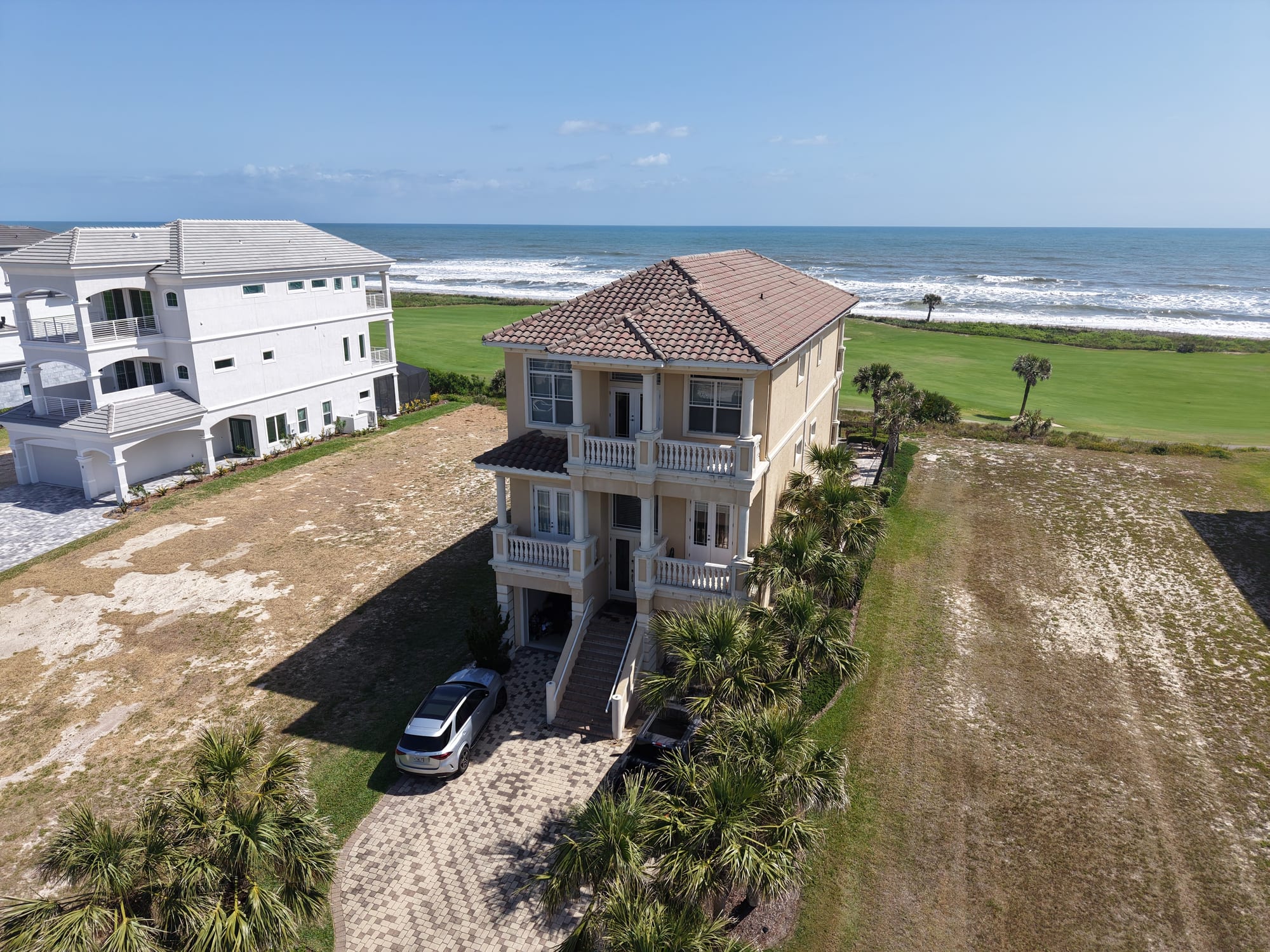
We have done this on some of the hardest roofs on the coast: 1,300 square feet of tile and a full fascia replacement 52 feet up on an Ocean Hammock home, and tile repair with a new chimney built 56 feet up on an oceanfront home in the same community. Both are in our projects. We are a family business on our third generation of roofers, with more than 40 years of hands-on experience in this weather. The best time to call is before the season. The second best is now.