We get this question on almost every replacement quote we write in Palm Coast, and the honest answer is that we have put all three on homes we are proud of. Shingle, tile, and metal each do their job on the coast when the right crew installs them the right way. The choice comes down to the house, the neighborhood, what you want your money to buy, and how long you plan to live there. Here is what we tell homeowners standing in the driveway.
How the coast treats a roof
Every roof in Flagler County fights the same four things: salt air, sun, rain, and wind. Salt goes after any exposed metal, which means fasteners, flashing, drip edge, and vents on every roof type, not just metal roofs. Summer UV cooks asphalt and dries out sealants. Afternoon downpours test every seam and valley. Wind looks for an edge it can get under. Each material has a different weak point on that list.
Shingle: the workhorse
Architectural shingle is the most common roof in Palm Coast for good reasons. It is the least expensive of the three up front, it goes on quickly, it comes in a wide range of colors, and it works on almost any roof shape, including steep ones. When a tree limb takes out a section, the repair is straightforward and blends in.
Where shingle struggles is heat and sun. Asphalt ages faster on the coast than inland, and the humid air encourages the dark algae streaks you see on north-facing slopes all over town. Algae-resistant shingle helps. Wind is the other concern, and it is almost always a nailing problem, not a shingle problem. Shingles nailed high, short, or with the wrong gun pressure lift at the edges in the first real storm.
That is why certification matters. We are manufacturer-certified Atlas installers, which means the manufacturer has trained our crew on its system and holds us to its installation spec, and that is usually what its strongest warranty coverage is tied to. The 4,500 square foot Atlas roof we installed on a secluded property in the heart of Palm Coast is shingle done properly, and the 11,800 square foot roof we put on a 16:12 pitch on rural acreage shows shingle handling a very steep, very large roof. Our shingle roofing page has more.
Tile: heavy, long-lived, and only as good as the crew
Concrete and clay tile is what most people picture on a coastal Florida home, and it is the signature roof in communities like Hammock Dunes and Ocean Hammock. It holds up to sun and salt better than anything else we install, and tile and metal typically outlast shingle by a wide margin.
Three things we tell every tile customer:
Weight. Tile is heavy. The house has to be framed to carry it. Homes built in tile neighborhoods usually are; an older shingle home may need a look at the structure before anyone promises you a tile roof.
The tile and the underlayment work together. Most roofers will tell you the underlayment is your real roof and the tile is just decoration on top. We disagree. On a tile roof done right, the tile and the underlayment work in unison. The tile is the first line of defense and should be doing most of the work. Water should not be expected to show up beneath the tiles on a regular basis, and an underlayment that is wet every afternoon is an underlayment that will not last. When we put on a tile roof, we put it on tight: tiles set snug to one another, hips and ridges closed properly, and the edges finished so wind-driven rain has nowhere to get in. The underlayment is there for the day a tile breaks, not for every storm.
Give the water somewhere to go. Tiles do break eventually, from a dropped limb, a storm, or someone’s boot. When one does, water that gets under it has to be able to drain back out at the eave instead of sitting on the underlayment. That is why we always advocate for weep holes at the eave closures, so anything that gets beneath the tile runs down and out the way the system was designed. It is a small detail that is easy to skip, and it is the difference between a cracked tile being a quick repair and a cracked tile quietly rotting a section of decking.
Keep untrained feet off it. Individual tiles can be replaced, which is a real advantage of the material. The catch is that walking a tile roof the wrong way breaks tiles, and a broken tile you do not know about is a leak waiting for the next storm. We have seen entire neighborhoods in the Hammock with their roofs torn up by this, and the cause was not weather. It was pressure washing crews who had never been taught how to walk a tile roof, cracking thousands of tiles across street after street while cleaning them. If someone needs to be on your tile roof for any reason, make sure they know where to step: on the heads of the tiles where they overlap, never in the middle of the pan. Better still, hire a roofer. We replaced 1,300 square feet of tile 52 feet up on an Ocean Hammock home, along with the fascia around the entire house, from a driveway barely wide enough for the lift, and on another Ocean Hammock home we replaced broken tile and built a new chimney 56 feet above the ground.
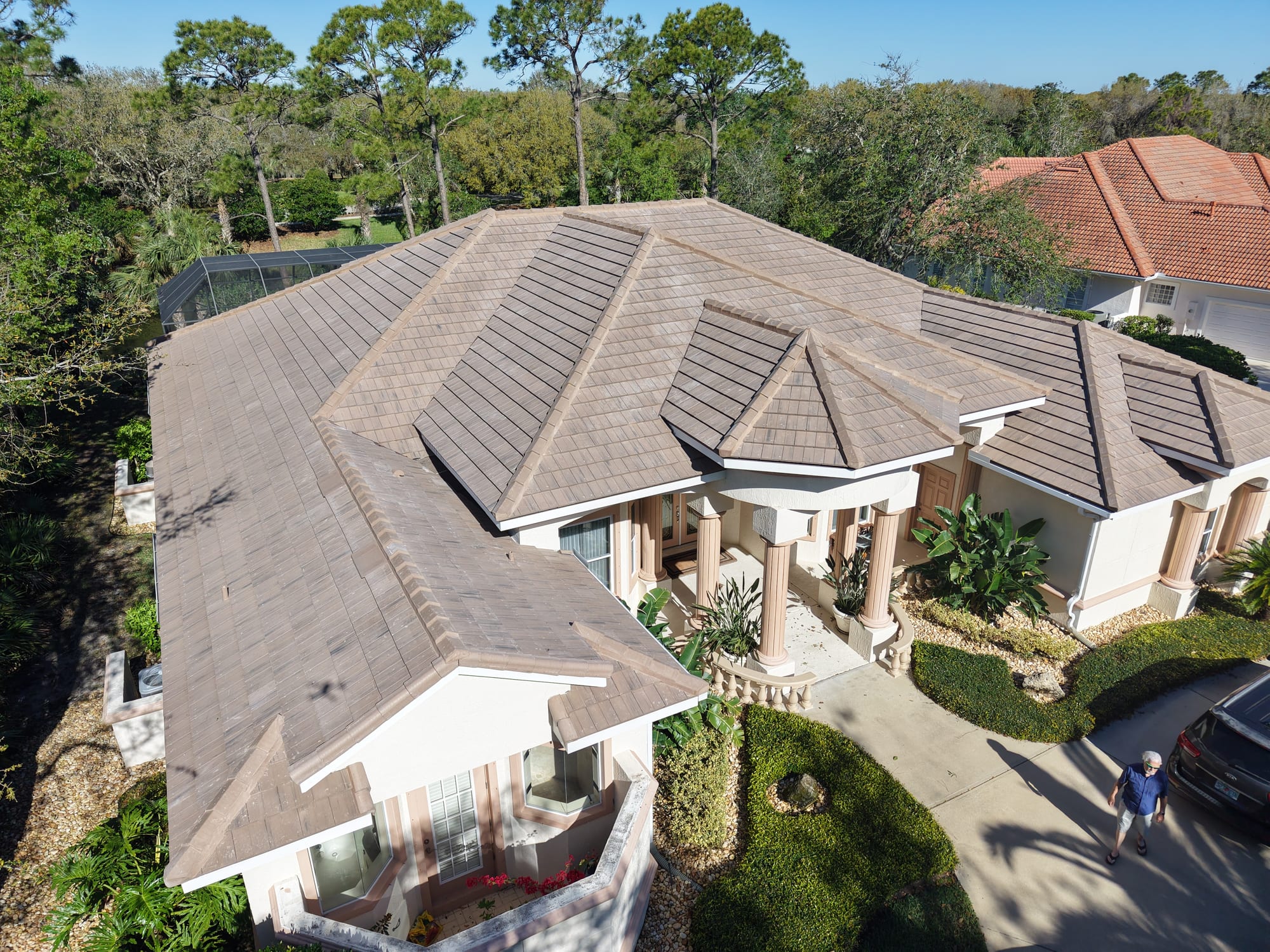
The 7,100 square foot Westlake concrete tile roof we installed in Hammock Dunes shows the finished product when the look of the neighborhood and the engineering under the tile both get their due. Our tile roofing page goes into more detail.
Metal: farm panel vs. standing seam
Metal has moved from barns and commercial buildings to some of the best-looking homes on the coast, and it comes in two main flavors.
Farm panel (exposed-fastener or ribbed panel) is screwed down through the face of the panel with gasketed screws. It is the simpler, more affordable metal roof, and it gives a home a clean farmhouse look. The trade-off is that every screw is a small penetration with a rubber washer that eventually weathers, so the fasteners need to be checked every so often. The 3,200 square foot farm panel roof we installed in Ormond Beach is the style done well.
Standing seam hides the fasteners under the raised seams and attaches the panels with clips that let the metal expand and contract with the heat. Fewer penetrations, a sharper look, and less maintenance, at a higher cost.
A few things that come up on every metal quote:
- Heat. Metal reflects more of the sun than asphalt does, and most homeowners notice a cooler attic.
- Maintenance. Keep branches off it and debris out of the valleys. On farm panel, have the fasteners looked at.
- Noise. The loud metal roof people remember is a barn, with panels over open framing. On a house, the metal goes over solid decking, underlayment, and an insulated attic, and rain sounds like rain.
- Look. Crisp and modern or farmhouse-traditional, depending on profile and color. In some tile neighborhoods it is not what the community expects.
See our metal roofing page for how we install both types.
The questions we ask before we recommend one
We do not walk up with a material in mind. We ask:
- How long do you plan to stay? A roof you will sell with in a few years and a roof you want to be your last are different decisions.
- What does the neighborhood expect? Many coastal communities have a clear look, and some have rules about it.
- What is the house built to carry? Framing, pitch, and roof complexity narrow the list quickly.
- What matters most to you? Lowest upfront cost, the longest stretch before the next roof, the look, or the least maintenance. You can usually have two of those, rarely all four.
- What went wrong with the roof you have? If a shingle roof failed early from wind, the answer may be better installation rather than a different material.
Side by side
| Shingle | Tile | Metal | |
|---|---|---|---|
| Upfront cost | Lowest | Highest | Middle to high |
| Service life on the coast | Shortest | Longest | Long |
| Weight on the structure | Light | Heavy | Light |
| Repairs | Easy and blend in | Tile by tile, careful footwork | Panel by panel |
| Heat in the attic | Absorbs the most | Moderate | Reflects the most |
| Maintenance | Low | Low; keep untrained feet off it | Low; fastener checks on farm panel |
| Look | Traditional, many colors | Coastal and Mediterranean | Farmhouse or modern |
What matters more than the material
After three generations of doing this, our honest conclusion is that the material you pick matters less than the four things under and around it.
Underlayment. It is the backup layer on every roof type, the one that has to hold when something on top fails, and it is where cheap bids save money because you cannot see it once the roof is on. On a tile roof it works together with the tile; it should never be doing the tile’s job every afternoon.
Flashing. Walls, chimneys, valleys, skylights, and pipe penetrations cause more leaks than the roofing material ever does. Flashing is where a roofer’s patience shows.
Fastening. Right nail, right place, right depth, right count. This is what holds a roof on in a storm, whatever is on top.
The crew. Our core crew has worked together for more than 30 years, and between us we carry over 40 years of hands-on roofing experience. The same people who roof the largest homes in Hammock Dunes roof modest homes in the center of Palm Coast, and the standard does not change.
If you are weighing a roof replacement, look through our finished work to see all three materials on real homes, then contact us or call (386) 864-9600. We will look at the house and tell you which roof we would put on it if it were ours. The inspection and the quote are free.